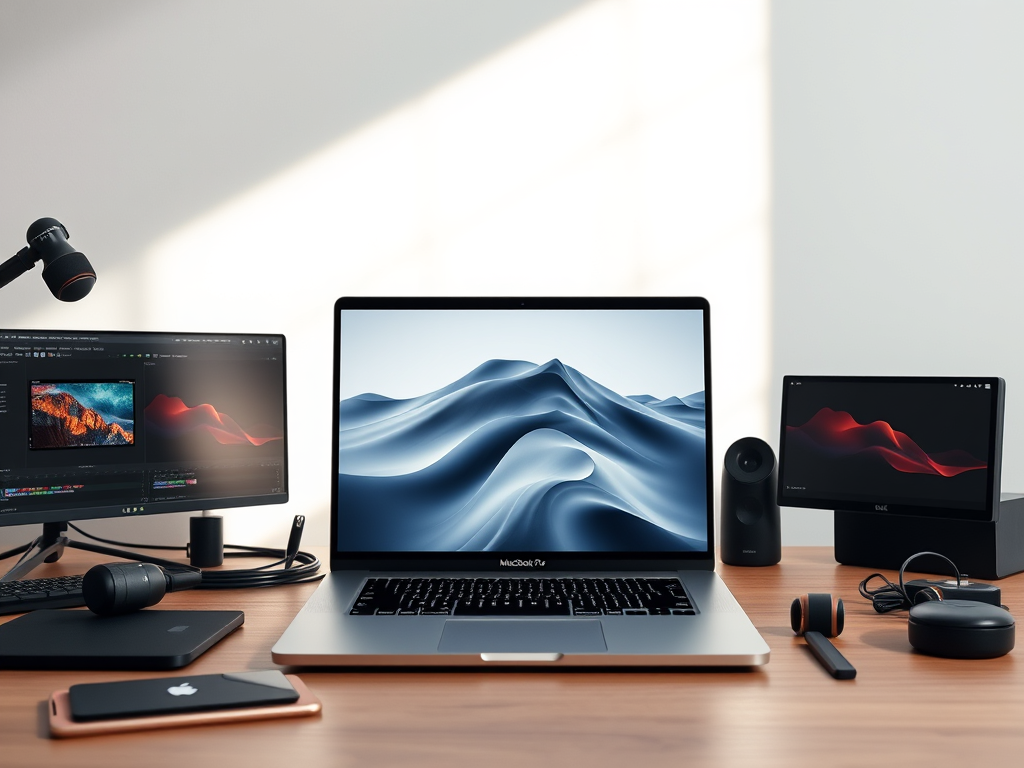
Yes is easier to say than no—especially when the sleek new MacBook Pro shows up with specs that could put a desktop to shame. Picture this: You’re deep into editing a massive 8K video project, juggling layered effects and live previews—and your laptop doesn’t even break a sweat. That’s the promise Apple is selling with its upcoming MacBook Pro models, fueled by the new M5 Pro and M5 Max chips.
This isn’t just a processor bump. This is Apple flexing its silicon muscle—and sending a signal to every professional, creator, and power user: The MacBook Pro is no longer just part of your workflow. It is your workflow.
The Silicon Powerhouse: M5 Pro and M5 Max
At the core of this next-gen evolution is Apple’s most ambitious chip yet. The M5 Pro and M5 Max, both built on TSMC’s bleeding-edge 3nm process, are expected to deliver a staggering 20–25% performance boost over their M4 predecessors. Apple has already proven it can outpace Intel and AMD in real-world performance per watt—now it’s doubling down.
M5 Pro: Up to 16 CPU cores and 22 GPU cores
M5 Max: Up to 18 CPU cores and a jaw-dropping 42 GPU cores
And this isn’t just raw power. It’s precision power. These chips are tuned for machine learning, video editing, gaming, simulation—you name it. Pair that with higher default RAM configurations, and you’re looking at a machine that eats complexity for breakfast.
Efficiency Meets Elegance
Apple’s design ethos has always been about the balance of form and function. With the M5 MacBook Pro, that balance remains rock solid.
While the chassis design is expected to remain largely the same—don’t expect any radical exterior transformations just yet—the focus is on fine-tuning. The mini-LED ProMotion displays with their buttery 120Hz refresh rates and eye-popping brightness aren’t going anywhere. Apple knows it already nailed this one.
But make no mistake: the real visual reinvention is coming with the M6 generation, likely in 2026 or 2027. That’s when OLED displays and a new chassis design will take center stage. For now, Apple’s playing a smart game—enhancing the internals while keeping the trusted outer shell.
Thunderbolt 5: Future-Proofing the Workflow
Here’s where things get exciting for pros. The new M5 MacBook Pro will support Thunderbolt 5, bringing massive bandwidth boosts and lower latency. What does that mean in real terms?
- Faster transfer speeds for enormous media files
- Seamless connections to external GPUs
- Multiple high-res monitors without stutter
- Enhanced connectivity for AI workflows and AR development
Yet, Apple isn’t cluttering up the design with extra ports. The port layout will remain mostly unchanged, striking a familiar balance between minimalist appeal and practical functionality.
Aesthetic Tweaks and New Colors
While the headline might be performance, Apple hasn’t forgotten its style-conscious user base. Rumors suggest a new color option will join the classic Space Black and Silver—perhaps a darker titanium hue or a bold midnight blue.
This subtle shift in aesthetics isn’t just vanity. It’s identity. Apple understands that when you open your laptop in a café or client meeting, it says something about you. These refinements are about making the MacBook Pro feel personal—without compromising its professional DNA.

Strategic Timing: M5 Now, M6 Tomorrow
Apple’s strategy is clear: use the M5 generation as a bridge—a supercharged, polished, uncompromising bridge—toward the dramatic leap that is the M6.
The M6 generation is expected to bring:
- OLED displays with deeper blacks, better color contrast, and improved energy efficiency
- A new chassis that could slim down bezels, lighten the load, and modernize the silhouette
- Possibly a stronger focus on AI integration and on-device machine learning with specialized accelerators
That redesign isn’t just cosmetic—it’s Apple’s way of resetting the standard. But the M5 ensures the journey there is smooth, powerful, and more than enough for the heavy demands of today.
Where and When?
According to respected analyst Ming-Chi Kuo, Apple’s high-end M5 chips may arrive as early as late 2025. That means we could see the M5-powered MacBook Pros drop just in time for the holiday season or Q1 of 2026.
Mass production is reportedly already underway in Taiwan via TSMC, with further high-end chip manufacturing planned for Apple’s Arizona and Houston facilities. Some of these chips are even being eyed for AI server use under the Apple Intelligence Private Cloud Compute initiative. That’s right—this isn’t just about laptops. It’s about infrastructure.
And that infrastructure will likely extend beyond MacBooks—into the next iPad Pro, a potential Mac Studio upgrade, and even a more affordable Apple Vision Pro down the line.
Why It Matters
This isn’t just Apple releasing another laptop. This is Apple quietly pivoting its entire hardware ecosystem toward a new generation of computing. Think about it:
- A new chip architecture with broader AI capabilities
- More unified and future-proofed connectivity through Thunderbolt 5
- Performance that challenges and often beats high-end desktops
- A proven strategy of iteration today to set up disruption tomorrow
The M5 MacBook Pro is a promise: the future of computing is faster, leaner, and more seamless—and it’s already arriving.
Final Thought
If you’re a video editor, 3D animator, data scientist, software developer, or power multitasker—this is your moment. The M5 MacBook Pro isn’t just an upgrade. It’s the machine that lets you push further, work smarter, and maybe even ditch your desktop.
Stay tuned. Apple’s M5 MacBook Pro is about to turn the industry on its head—and this time, it’s not just evolution. It’s escalation.